The goal of limiting global warming to 1.5˚C above pre-industrial levels is outlined in the Paris Agreement, which was adopted in 2015. According to various climate models and assessments, the world is currently on a trajectory that could lead to reaching the 1.5˚C target sometime between 2030 and the early 2050s if current trends continue.
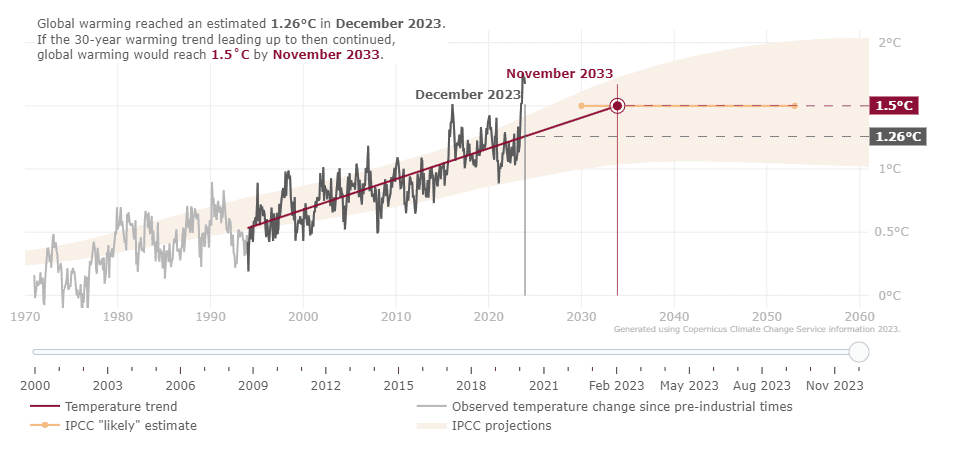
It’s important to note that these are projections and subject to change based on various factors, including global efforts to reduce greenhouse gas emissions. The Intergovernmental Panel on Climate Change (IPCC) regularly releases assessment reports that provide updated information on climate change projections, but the exact timing of reaching specific temperature targets depends on future developments.

To get the most accurate and up-to-date information on the current status of global warming and progress towards the 1.5˚C target, it is recommended to refer to the latest IPCC reports and other relevant scientific sources.

Source: IPCC
Featured image credit: rawpixel | Freepik

Image: Figure 12 - Global mean annual number of marine heatwave (MHW) days from ERA5 (1940–2025), OISST (1982–2025), OSTIA (1982–2025), and CRW (1985–2025), and the mean of these shown in black
Earth’s heat buildup accelerates as global warming reaches 1.37 °CClimateFacts

Earth’s heat buildup accelerates as global warming reaches 1.37 °C

Human-caused warming reached 1.37 °C above pre-industrial levels in 2025, while greenhouse gas emissions and key climate indicators remained at or near record highs Summary:…
SourceSourceJune 14, 2026 Full article
Image: Surface air temperature anomaly for July 2026
Western Europe experienced hottest June-July on record: EU monitorFactsNews

Western Europe experienced hottest June-July on record: EU monitor

Paris, France | AFP | Muser NewsDesk Western Europe experienced its hottest June-July on record as climate change fuels an historic summer of heat, drought and…
SourceSourceAugust 10, 2026 Full article
Image: Annual surface air temperature anomalies for the Arctic region (north of 40°N) for each year from 2002 to 2025, relative to the average for the 1991–2020 reference period
2025 ranked as third hottest yearNewsFacts

2025 ranked as third hottest year

Global temperatures remained near historic highs in 2025, making it the third hottest year ever recorded and extending a run of exceptional warmth that now…
Muser NewsDeskMuser NewsDeskJanuary 14, 2026 Full article