
Summary:
Prolonged exposure to extreme heat may accelerate biological aging in older adults, according to a study published in Science Advances.
Researchers from the USC Leonard Davis School of Gerontology found that people living in areas with frequent heat waves showed greater biological aging at the molecular level than those in cooler regions. The study analyzed data from more than 3,600 participants aged 56 and older from throughout the U.S, measuring DNA methylation changes in blood samples over six years.
The findings suggest that high heat exposure contributes to faster aging, even when controlling for lifestyle and socioeconomic factors. Participants living in regions with frequent heat days, such as Phoenix, Arizona, exhibited up to 14 months of additional biological aging compared to those in milder climates. The research shows the vulnerability of older adults to rising temperatures and points to the need for climate-adaptive infrastructure, including increased urban green spaces and shaded public areas.
Study: Extreme heat may speed up aging in older adults
A new USC Leonard Davis School of Gerontology study suggests greater exposure to extreme heat may accelerate biological aging in older adults, raising new concerns about how climate change and heat waves could affect long-term health and aging at the molecular level.
People in neighborhoods that experience more days of high heat show greater biological aging on average than residents of cooler regions, said Jennifer Ailshire, senior author of the study and professor of gerontology and sociology at the USC Leonard Davis School.
People in neighborhoods that experience more days of high heat show faster aging at the molecular level than residents of cooler regions, say USC researchers
Biological age is a measure of how well the body functions at the molecular, cellular, and system levels, as opposed to chronological age based on one’s birthdate; having a biological age greater than one’s chronological age is associated with higher risk for disease and mortality.
While exposure to extreme heat has itself long been associated with negative health outcomes, including increased risk of death, heat’s link to biological aging has been unclear.
Measuring epigenetic changes
Ailshire and her co-author Eunyoung Choi, USC Leonard Davis PhD in Gerontology alumna and postdoctoral scholar, examined how biological age changed in more than 3,600 Health and Retirement Study (HRS) participants aged 56 and older from throughout the U.S. Blood samples taken at various time points during the six-year study period were analyzed for epigenetic changes, or changes in the way individual genes are turned “off” or “on” by a process called DNA methylation.
The researchers used mathematical tools called epigenetic clocks to analyze methylation patterns and estimate biological ages at each time point. They then compared participants’ changes in biological age to their location’s heat index history and number of heat days reported by the National Weather Service from 2010 to 2016.
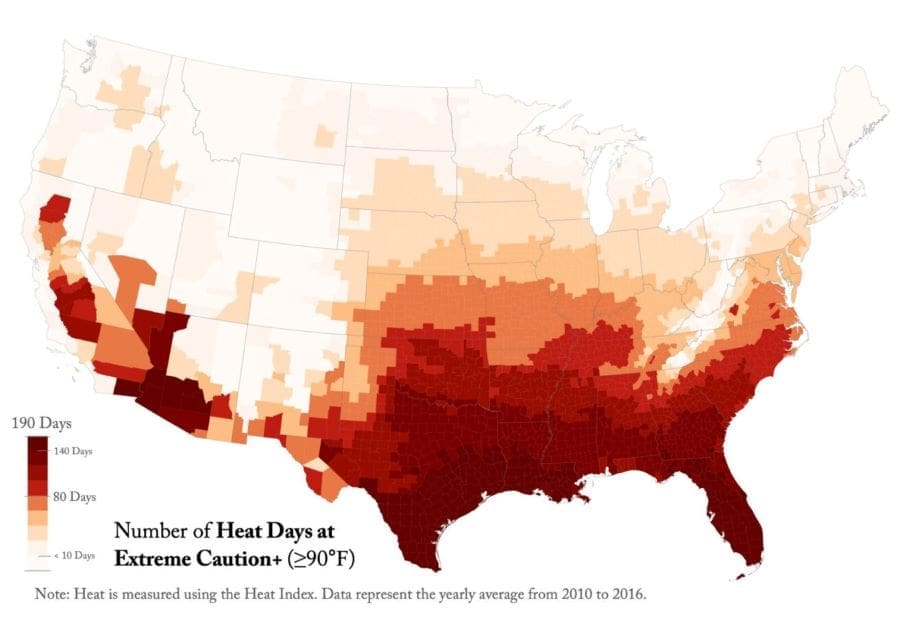
The National Weather Service Heat Index Chart categorizes heat index values into three levels based on the potential risk of adverse health effects. The “Caution” level includes heat index values ranging from 80 °F to 90 °F (aprox. 27 °C to 32 °C), the “Extreme Caution” level includes values between 90 °F and 103 °F (aprox. 32 °C to 39 °C), and the “Danger” level includes values between 103 °F and 124 °F (aprox. 39 °C to 51 °C). Days in all three levels were included as heat days in the study.
The analysis revealed a significant correlation between neighborhoods with more days of extreme heat and individuals experiencing greater increases in biological age, Choi said. This correlation persisted even after controlling for socioeconomic and other demographic differences, as well as lifestyle factors such as physical activity, alcohol consumption and smoking, she added.
“Participants living in areas where heat days, as defined as Extreme Caution or higher levels (≥90°F/≥32°C), occur half the year, such as Phoenix, Arizona, experienced up to 14 months of additional biological aging compared to those living in areas with fewer than 10 heat days per year,” she said. “Even after controlling for several factors, we found this association. Just because you live in an area with more heat days, you’re aging faster biologically.”
All three epigenetic clocks employed in the study – PCPhenoAge, PCGrimAge, and DunedinPACE – revealed this association when analyzing epigenetic aging over a 1- to 6-year period. PCPhenoAge also showed the association after short (7 days) and medium (30-60 days) periods of time, indicating that heat-related epigenetic changes could happen relatively quickly, and some of them may accumulate over time.
Climate implications for communities
Older adults are particularly vulnerable to the effects of high heat, Ailshire said. She noted that the study used heat index, rather than just air temperature, to take relative humidity into account as they analyzed results.
“It’s really about the combination of heat and humidity, particularly for older adults, because older adults don’t sweat the same way. We start to lose our ability to have the skin-cooling effect that comes from that evaporation of sweat,” she explained. “If you’re in a high humidity place, you don’t get as much of that cooling effect. You have to look at your area’s temperature and your humidity to really understand what your risk might be.”
The next steps for the researchers will be to determine what other factors might make someone more vulnerable to heat-related biological aging and how it might connect to clinical outcomes. In the meantime, the study results could also prompt policymakers, architects, and others to keep heat mitigation and age-friendly features in mind as they update cities’ infrastructure, from placing sidewalks and building bus stops with shade in mind to planting more trees and increasing urban green space, Ailshire said.
“If everywhere is getting warmer and the population is aging, and these people are vulnerable, then we need to get really a lot smarter about these mitigation strategies,” she said.
***
Funding for the study included the USC/UCLA Center on Biodemography and Population Health through a grant from the National Institute on Aging, National Institutes of Health (P30AG017265) and The Network on Life Course Health Dynamics and Disparities in 21st Century America funded by the National Institute on Aging, National Institutes of Health (R24AG045061).
Journal Reference:
Eun Young Choi, Jennifer A. Ailshire, ‘Ambient outdoor heat and accelerated epigenetic aging among older adults in the US’, Science Advances 11, eadr0616 (2025). DOI: 10.1126/sciadv.adr0616
Article Source:
Press Release/Material by Elizabeth Newcomb | University of Southern California
Featured image credit: Freepik