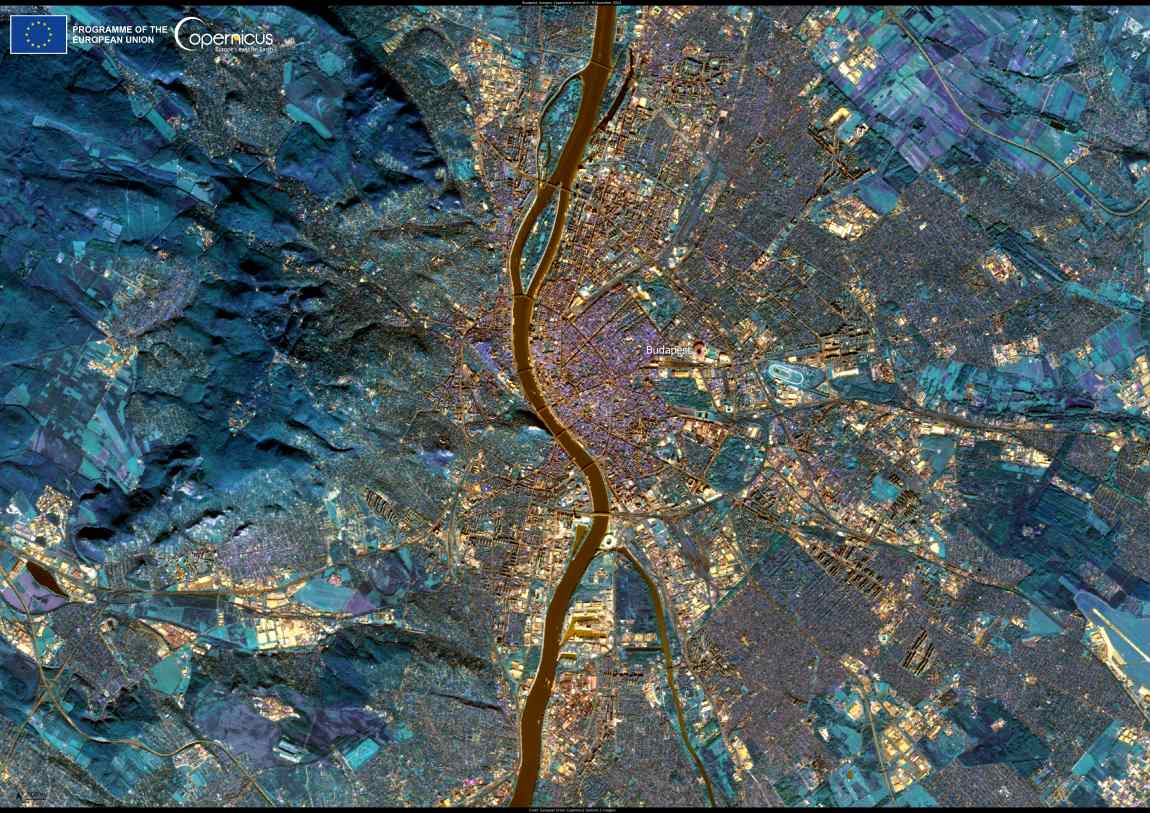
Budapest, Hungary’s capital and largest city, is situated along the banks of the Danube River, dividing the city into Buda and Pest. The western side, Buda, is connected by numerous bridges to the eastern Pest.
Since 1934, Budapest has been known as the Spa City thanks to its rich heritage of thermal baths, which are supplied by more than 100 natural springs and drilled wells. These sources bring approximately 70 million litres of thermal water to the surface each day.
Budapest and the surrounding areas can be seen in this false colour image produced with the data acquired by one of the Copernicus Sentinel-2 satellites on 9 November 2024.

In November 2024, Budapest will be the hub of the EU Space Programme for two days. 20 November marks the start of the EU Space Days, an event organised by the European Commission under the auspices of the Hungarian Presidency of the European Union.
The event will bring together policymakers, space industry players, and entrepreneurs from various sectors to exchange insights and experiences on how businesses, governments, and society at large can benefit from the EU Space Programme and its existing components such as Galileo, EGNOS, and Copernicus, as well as new components such as GOVSATCOM and IRIS2. The event will be live-streamed on social media. More information is available here.
Featured image: Budapest Credit: European Union, Copernicus Sentinel-2 imagery